The program standard

𝑖SIP

the inner-𝑖 Soundness & Integrity Program

MIL-STD-1530D β€” the USAF Aircraft Structural Integrity Program β€” translated one-for-one onto a human life. Not aviation used as decoration. The arithmetic is actually the same: declared service life, uncontrolled loads, known flaws you mostly cannot see, and a catastrophic failure mode. Only the units change.

You are not weak, and you are not broken. You are uncertificated β€” operating without placards, on a mission you were never shown the order for. We issue the paperwork.
Insider Threat Β· the governing premise

You are the load and the crack

In the ASIP policy stack nothing starts with the technical standard. It starts with AFPD 63-1, a policy directive that does exactly one thing: it states that an integrity program shall exist. It does not say how. It says the alternative β€” running the fleet without one β€” is not permitted. 𝑖SIP needs the same thing at the top, and Insider Threat is it.

The structure and the flaw are the same object. Therefore no program built on the assumption of your own soundness can be trusted, and every program must be built on measurement instead.

Once you accept that the flaw is already present and already yours, "inspection" stops being self-improvement and becomes crack detection. "Damage tolerance" stops being resilience-talk and becomes an operating posture: I will fly with a known flaw, on a known growth curve, under a known inspection interval, and I will not pretend otherwise.

The compensating half, from Converge to Diverge: this is not a sentence. The pinch in a nozzle is not damage β€” it is the precondition for thrust. A flaw under a managed program is what generates the very data that lets the structure be trusted. Ease cannot make a diamond. Pressure can. Insider Threat without that second half is despair. With it, it is engineering.

The governing hierarchy

ASIP works because authority flows in one direction and data flows back in the other. 𝑖SIP inherits that shape exactly.

Policy directive Insider Threat β€” declares that an integrity program shall exist; states the threat modelASIP: AFPD 63-1
Responsibilities iSight Laboratories Operating Charter β€” who does what; how the program is sustainedASIP: AFI 63-1001
Technical standard The 𝑖SIP Standard β€” 52 translated tasks, plus Task 0ASIP: MIL-STD-1530D
Program plan Personal 𝑖SIP Master Plan β€” one per individual; tailors the 52 to this structureASIP: ASIP Master Plan
Maintenance plan 𝑖SMP β€” 𝑖Soundness Maintenance Plan β€” the consolidated schedule of inspections, repairs, modsASIP: FSMP
Life analysis 𝑖DADTA β€” Durability & Damage Tolerance Analysis; sets inspection intervals from load historyASIP: DADTA
Individual tracking 𝑖IAT β€” Individual 𝑖 Tracking; adjusts intervals for actual usage severityASIP: IATP
Technical orders 𝑖SRM β€” 𝑖Soundness Repair Manual β€” repair procedures, inspection procedures, inspection methodsASIP: -3 / -6 / -36 TOs
Operations Life Operations β€” where the loads actually happenASIP: Force Operations

Soundness and Integrity β€” the two words

Integrity comes from the Latin integer β€” in- plus tangere, untouched. Whole because nothing has been taken away, and undivided because it was never cut. English never split the engineering sense from the moral sense β€” structural integrity and personal integrity are the same word describing the same property of two different structures. That is the single strongest piece of evidence that 𝑖SIP is a transfer rather than a metaphor.

Undividedness, though, is not purity. 0 and 1 are both required. A structure that can only output 1 β€” only yes, only expansion, only light β€” is not whole. It is stuck. Wholeness is the capacity to hold both halves across the 𝑖-axis, and the loss of integrity is the amputation of one of them.

WordQuestionFailure looks like
SoundnessCondition. Am I whole, rested, undamaged, fit to fly?Fatigue, corrosion, accumulated wear, burnout β€” damage to the material
IntegrityCoherence. Am I one piece, or divided between what I want and what I keep agreeing to?Saying yes while meaning no; the outward answer and the inward answer no longer being the same object

You can be entirely undamaged and entirely divided. You can also be perfectly coherent and badly worn. Most people arriving at this program are both at once β€” and a program with only one word for it can only see half of what is wrong. A person who says yes while meaning no is not integer. The yes and the no are two pieces. That makes people-pleasing a structural condition with a structural remedy, rather than a personality defect to be scolded out of.

Who this standard is written against

A standard is written against a threat. This one's is specific, and naming it changes which tasks carry the most weight. The people this program is for tend to share some combination of nine traits:

say yes reflexively, cannot say no please easy prey for anyone willing to exploit that carry anxiety or depression marginalized, made to feel expendable talented, learning-hungry, challenge the status quo innovators who overcommit and burn out tradespeople who over-sacrifice want rigorous tools, love to dream past reason

Those are not nine problems. They are one failure mode and its consequences: the structure accepts every load applied to it.

Anxiety, depression, burnout and the sense of being expendable are not additional traits on that list β€” they are what happens downstream of unrestricted loading. In the vocabulary of this standard, the population is characterized by a missing Strength Summary & Operating Restrictions. No placards. No never-exceed limits. A load spectrum filed by other people. And because nothing in the paperwork forbids the mission, every mission gets assigned, and every load becomes an ultimate load.

Exploitation is a documentation gap, not a character flaw. If there is no SSOR, there is nothing for a demanding operator to violate.

The captured MAJCOM

In ASIP, the Major Command sets service life, planned usage, required readiness and budget. The System Program Office translates that into plans. They are deliberately separate functions, and the separation is what prevents a program from quietly redefining its mission to match whatever it happens to be achieving.

For this population, that separation has collapsed in a specific direction: MAJCOM has been outsourced. An employer, a family system, an institution, or an accumulated habit of deference is setting the usage β€” and the SPO, the person's own executive function, is loyally and competently translating someone else's requirements into plans. The planning is often excellent. That is precisely what makes it hard to see. A well-run SPO serving a captured MAJCOM produces a person who is extremely effective at a life they did not choose, and who cannot work out why competence has not produced relief.

This has a hard programmatic consequence, and it is why the program has a Task 0: you cannot open at i5.1.2. Ask a person with a captured MAJCOM to declare their design service life and intended usage and they will faithfully declare someone else's β€” and every task built on that declaration will be rigorously executed against the wrong requirement. The analysis will be correct and the answer will be worthless.

β—ˆ CHARTER LIMIT β€” AUTHORITY

iSight Laboratories is engineering authority, never command authority. We supply the analysis, the standard, the instruments and the certification basis. MAJCOM authority is returned to the individual as the first deliverable, not retained as the business model. Any product or engagement that sets a customer's mission for them is out of scope regardless of how well it would sell β€” because it reproduces the original injury with better vocabulary, and would be trusted precisely because it does.

The engine, end to end

The program map

Because the shape was already yours. Converge to Diverge and MIL-STD-1530D describe the same geometry. Tasks 0–III narrow you from everything you might be down to what you actually are and what actually loads you. Task IV is the throat β€” certification, the pinch, the narrowest point in the program. Task V is expansion. The pinch is not the punishment.

Drawing sheet β€” scroll sideways on a narrow screen to read the full width.

Layer 1 β€” the wave: one service life, rising and falling. Reflect it β†’

GOVERNING STACK INSIDER THREAT β–Έ iSight Labs Charter β–Έ iSIP Standard Β· 52 tasks + Task 0 β–Έ Personal iSIP Master Plan β–Έ iSMP Β· iSRM Β· placards Β· iDADTA Β· iIAT You are the load and the crack. Authority flows down; data flows back up. 𝑖-axis C O N V E R G E HINDsight π‘–β€ŠNSight D I V E R G E FOREsight THE THROAT START HERE Who is commanding me? TASK 0 Configuration & Authority i5.0.1 – i5.0.3 Career Load History Mind My Material Open: Authority TraceAuthority Trace What was I built for? TASK I Design Information i5.1.1 – i5.1.7 Converge to Diverge Open: Mission DeclarationMission Declaration Open: Governor / CriteriaGovernor / Criteria What loads me β€” and what does it predict? TASK II Analysis & Dev Testing i5.2.1 – i5.2.15 Hindsight 80/20 Hindsight Framework Open: Joint InventoryJoint Inventory Open: Loads Evaluation β€” the free body diagram Β· i5.2.2Free Body Β· i5.2.2 Reality gets a vote. TASK III Full-Scale Testing i5.3.1 – i5.3.8 + i5.3.2.1 Flight Test Open: Findings RegisterFindings Register Open: Modal Survey β€” i5.3.2.1, the ring-down testModal Survey TASK IV Certification & Life Mgmt Development i5.4.1 – i5.4.7 Run the loop. Forever. TASK V Life Management Execution the rest of your life Hindsight Daily Β· L/ESS + IAT Quit or Stay Β· i5.5.14 Open: A-1 Exceedance Auth.A-1 Exceedance Auth. Open: A-2 Envelope ExpansionA-2 Envelope Expansion Open: ACI Deep Audit Β· i5.5.8ACI Deep Audit Β· i5.5.8 OBJECTIVE 5 The method passes on. Insider Threat β†— Β· Smile High Podcast β†— You stop being the aircraft and become the engineer. 6 Pack Security Β· Tall Tales Engineering β†— THE CORE OFFER β€” four artifacts out of the throat Open: β˜… A-0 Placard Set Β· i5.4.2β˜… A-0 Placard Set Β· i5.4.2 Certification Basis Β· i5.4.1 iSMP β€” Maintenance Plan Β· i5.4.3 iSRM β€” Repair Manual Β· i5.4.7 The narrowest point in the program. Everything upstream compresses into these four. i5.5.3 β€” iDADTA updates · real logged data revises the analysis and moves every interval i5.5.13 β€” Recertification · a changed mission sends you back to Task 0. New usage, new certificate. A-2 results raise the certified envelope β€” the placards move outward The loop does not return you to where you started. It returns you with a larger envelope. Compress Β· ignite Β· expand β€” and the next pass runs at a higher certified limit. Available now In development β˜… flagship Β· solid arrows = flow Β· dashed arrows = feedback
iSight Laboratories LLC Β· iSightLabs-26-0003 𝑖SIP Program Map Β· Working Draft v0.5 Β· 9 August 2026
Where to start

Task 0, always. Never Task I.

Ask someone whose command authority has been captured to declare their service life and they will faithfully declare someone else's β€” and every task above it gets rigorously executed against the wrong requirement. The analysis comes out correct and the answer comes out worthless.

The throat is the business

Four artifacts, one flagship.

Everything upstream compresses into four artifacts, and the placard set is the flagship. A boundary stated as a preference is negotiable; a certified limit is not. That conversion is what iSight Labs actually sells β€” and three of the four artifacts are still unbuilt.

The ending that isn't one

Three loops return.

𝑖DADTA revises the analysis, recertification sends a changed mission back to Task 0, and envelope expansion moves the placards outward. Then the exhaust leaves the engine entirely β€” Objective 5, the method passing to the next structure.

The dashed cream chips are live β€” click one to open its working instrument in a new tab. Every sheet is a station of The 𝑖SIP Companion Workbook (published β€” softcover & hardcover on Amazon β†—), which carries the worked examples, plain-language bridges, and caveats that keep each sheet in context.

The three triangles

The three lenses

Not branding. The three time-domains any integrity program has to operate in simultaneously β€” and each has a home in the task lattice.

HINDsight

What has actually been loaded onto me, and in what sequence?

L/ESS, load spectra, usage data.
i5.2.2 Β· i5.2.3 Β· i5.4.4 Β· i5.5.1

𝑖NSight

What am I made of, and what are my real allowables?

Material characterization, allowables, stress analysis.
i5.1.7 Β· i5.2.1 Β· i5.2.4

FOREsight

Where is the crack going, and when do I have to look again?

DADTA, crack growth, risk analysis, service life.
i5.2.6 Β· i5.2.14 Β· i5.2.15 Β· i5.5.3

You cannot do foresight without hindsight. Crack growth prediction requires a load spectrum, and a load spectrum is a record of the past. This is why Hindsight is named first and why the daily log is the foundation product rather than the accessory. Prediction is not intuition. It is arithmetic performed on history.

Part II Β· the standard

Fifty-two tasks, plus Task 0

MIL-STD-1530D has five functional tasks and fifty-two numbered ones. 𝑖SIP has six and fifty-five β€” the extra functional task comes first, and its three sub-tasks are added under the license of i5.5.15 β€” Others as Required, which exists precisely so a program can add what its structure requires. The 52 translated tasks remain 1:1 with the standard. Task 0 is an addition, clearly marked as such, and the numbering keeps that visible. One further addition sits inside the lattice rather than beside it — i5.3.2.1, the Modal Survey — numbered as a sub-task of Pre-Flight Verification precisely so the count of fifty-five does not move.

Tasks I–IV are executed as reconstruction, not as design. Nobody executes 𝑖SIP from a clean sheet. You arrive mid-life with an airframe already flown, already loaded, already cracked, and with no design data package. The honest entry point is not "design your life" β€” it is closer to a grandfathered type certificate under continued airworthiness review: you were certified to criteria you didn't set, by processes you have no records of, and the job now is to establish whether that certificate still holds under current usage.

FILTER

Part III Β· the charter

Every product is a numbered task

iSight Laboratories maintains the standard and builds the instruments that let a person execute it. That is the whole business. If a product cannot be assigned to a numbered 𝑖SIP task, it is either mis-scoped or it is revealing a task the standard hasn't articulated yet. That test is the discipline this page exists to impose.
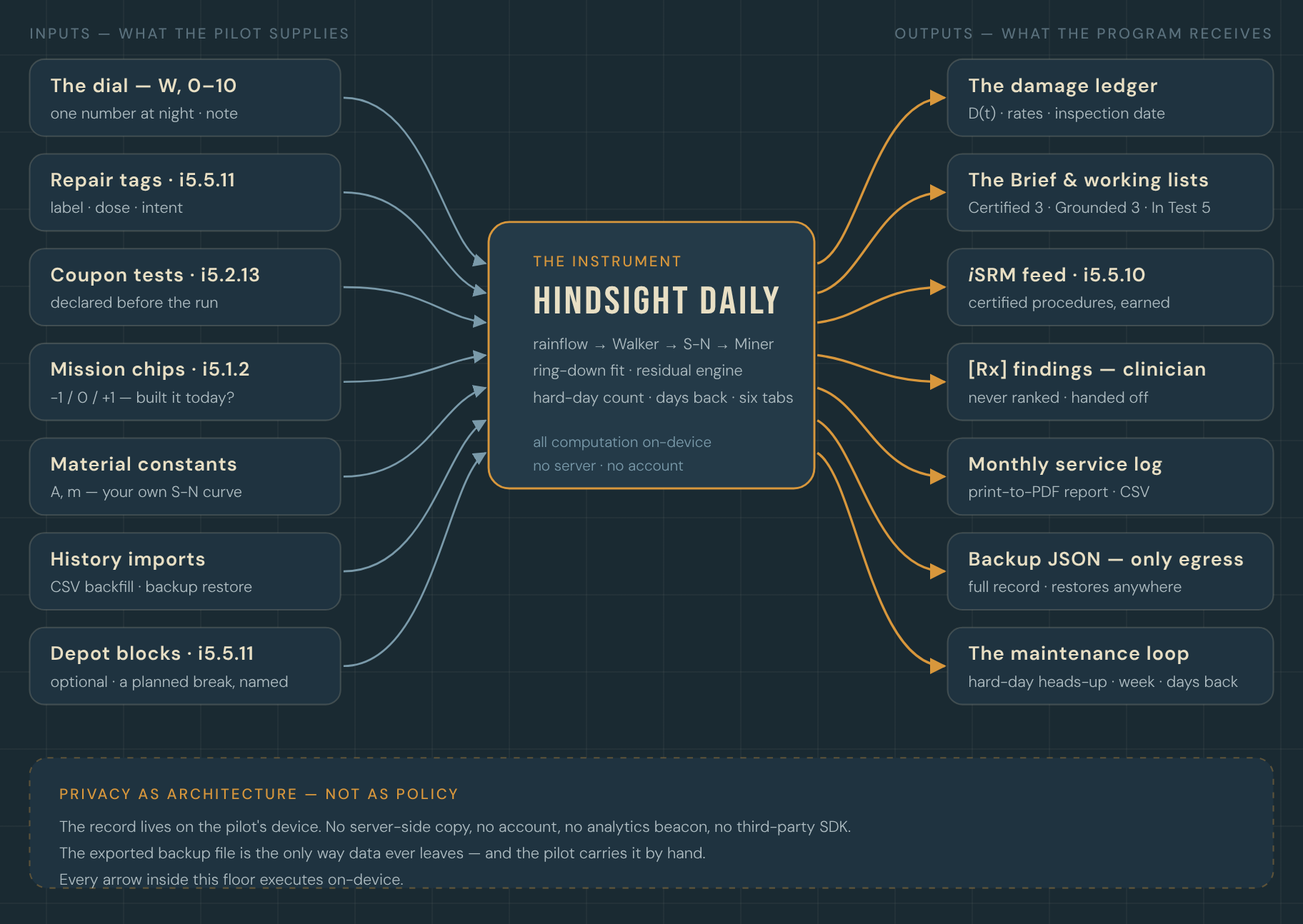
See where Hindsight Daily feeds the program β–Ύ Hindsight Daily map β€” one number a night, five consumers: the nightly record feeds the fatigue math, mission tracking, inspection intervals, findings triggers, and recertification evidence
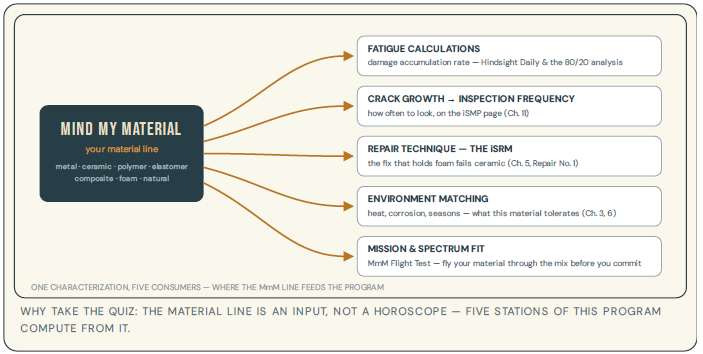
See where your Mind My Material line feeds the program β–Ύ Mind My Material map β€” one characterization, five consumers: your material line feeds fatigue calculations, crack growth and inspection frequency, repair technique, environment matching, and mission fit
Product𝑖SIP taskRole in the programStatus
Insider Threat (books β€” Amazon β†—)Policy layer
above i5.1.1
The governing premisePublished
Career Load Historyi5.0.2 Β· i5.2.2 Β· i5.2.3Load inventory, and the trace back to who assigned itAvailable now
The Loads Evaluation β€” free body diagrami5.2.2Every current force named and sized β€” lift, weight, thrust, drag, wind, gust β€” and the balance read liveAvailable now
Mind My Material (+ Deep-Dive, Compare, All About)i5.0.1 Β· i5.1.7 Β· i5.2.1Configuration, material identification, allowablesAvailable now
Converge to Divergei5.1.3 Β· i5.1.4 Β· Β§0.4The coordinate system β€” design criteria, damage-tolerance posture, the 0-and-1 undividedness thesisAvailable now
Hindsight Frameworki5.2.3Spectrum methodology β€” how load history becomes analyzable spectraAvailable now
Hindsight 80/20 Fatigue Analysisi5.2.5 Β· i5.2.6 Β· i5.5.3Durability & damage tolerance analysis β€” recurring, not one-timeAvailable now
Flight Testi5.3.3Instrumented live operationAvailable now
Modal Surveyi5.3.2.1Ground vibration test β€” the structure's own properties (ring-down, set point, daily jolt) rather than the wear on themAvailable now
Repair Bayi5.5.10 Β· i5.5.11 Β· i5.2.13The maintenance record β€” which recovery procedures actually work, which read as maintenance-induced damage; three capped lists, coupon tests, reads at the inspection intervalAvailable now
Quit or Stayi5.2.15 Β· i5.5.14Economic service life decisionAvailable now
𝑖SRM Repair Manuali5.4.7 Β· i5.5.10 Β· i5.5.11Technical orders and repair execution1 of 8 procedures Β· live feed from the Repair Bay
The 𝑖SIP Companion Workbook (see Books β†—)i5.0.1 – i5.5.13The bound program β€” philosophy (Vol. I), plain-language bridges, worked examples, and every worksheet in printPublished Β· Amazon β†—
𝑖SIP Working Instruments (Authority Trace Β· Mission Declaration Β· Governor Β· Joint Inventory Β· Findings Register Β· Envelope Mgmt A-0/A-1/A-2 Β· Deep Audit)i5.0.2 Β· i5.1.2 Β· i5.1.3 Β· i5.1.7 Β· i5.3.8 Β· i5.4.2 Β· i5.5.8The seven working sheets of the standard β€” browser-based, private-by-default, form-block emittersAvailable now β€” provisional tier
Hindsight Daily (+ Walkthrough)i5.4.4 Β· i5.4.5 Β· i5.5.1 Β· i5.5.2L/ESS and IAT β€” design and execution. The voice of the record.Available now
Smile High Podcast / YouTube (Apple Podcasts β†— Β· YouTube β†—)Objective 5Method transferAvailable now
6 Pack Security (work in progress β€” see Books β†—)Objective 5Method transferIn development
Tall Tales Engineering (Rhigle Rage in Timber Town β†—, Feaver Fever in Spillage Village β†—)Objective 5Method transfer to the next generation β€” the earliest structure the method can reach, before the first bad placard is ever acceptedPublished

Coverage analysis β€” and the roadmap it produces

Mapping the products onto the lattice makes the gaps visible. Ranking those gaps against the population makes the roadmap. The pattern: the existing line is strong at measurement and weak at commitment. Every product that tells a person about themselves is built. Every product that requires the person to declare something and be held to it is not. For a population whose defining failure is the inability to declare a limit, that is not a minor gap β€” it is the gap where the entire clinical value of the program sits.

#GapTaskWhy it ranks here
1Placard set / SSOR β€” the never-exceed list, derived from analysis, written as limits built β€” provisional β†—i5.4.2The flagship. Converts boundaries from preferences into certified limits. Nothing else on this list changes a life faster.
2Certification basis β€” a dated, conditional, evidenced, revocable fitness statementi5.4.1A certified structure with a documented life is the structural opposite of expendable. No competing framework issues one.
3Command authority determination β€” the load-to-authority trace built β€” provisional β†—i5.0.2Without it, every downstream declaration is someone else's. The true entry point of the program.
4The 𝑖SMP β€” the consolidated personal maintenance plani5.4.3The keystone artifact; every other product feeds it. The one document a customer should never lose.
5Mission declaration β€” a structured tool producing a written service life and mission mix built β€” provisional β†—i5.1.2Only meaningful after i5.0.2. Sequenced accordingly.
6Design criteria β€” the clamps / braces / initial-crookedness governor model, productized built β€” provisional β†—i5.1.3Supplies the analysis the placards trace back to
7Joint inventory β€” relationship structural assessment: joint type, load path, inspectability built β€” provisional β†—i5.1.7Where exploitation actually enters the structure
8Deep audit β€” Analytical Condition Inspection, high-depth and low-frequency built β€” provisional β†—i5.5.8Finds what routine inspection wasn't designed to look for
9Findings closure β€” a findings register with dispositions built β€” provisional β†—i5.3.8Prevents the program from becoming endless self-examination without closure

The data spine

One architectural decision unifies all of it, and it is build item zero: every 𝑖SIP instrument emits a structured output β€” a "form block" β€” into one personal record. The record is the Life Management Database (i5.4.6). Hindsight Daily is its daily accumulator and voice. The 𝑖SMP is its rendered display. A form block is small: which task produced it, when, and a handful of typed fields. Every existing page becomes an emitter by adding an export; every future page is designed as one. That is what turns a collection of interesting pages into a program that customizes itself from the person's own inputs.

Three tiers of delivery

The ordering is deliberate: authority before analysis, restriction before optimization.

TierWhat it isWhy here
Entry
Task 0
Configuration, command authority, as-found baselineLow cost, and non-negotiable. Everything sold above this tier is unsound without it β€” selling analysis to someone with a captured MAJCOM is selling precision on the wrong requirement.
Program establishment
Tasks I–IV
Four artifacts: Personal 𝑖SIP Master Plan, a placard set, a certification basis, an 𝑖SMPThe core offer. The placard set is what the customer will describe to other people.
Sustained program
Task V
Logging, periodic 𝑖DADTA updates, recertification on change, ACI on a long intervalASIP without Task V is a binder on a shelf β€” and a placard set issued once to a person who cannot say no will erode without an interval that re-issues it.
Appendix A Β· envelope management

How to carry a placard you fully intend to exceed

A standard that only says don't fails this person twice. The compliant half obeys and quietly resents it. The other half breaches and conceals the breach β€” and concealment is an integrity failure by this program's own definition, the outward answer and the inward answer becoming two objects. A program that produced that outcome would be manufacturing the exact defect it was written to repair.

So a placard does not forbid. It prices. Limit load is the maximum expected in service, below which the structure suffers no permanent deformation. Ultimate load is conventionally 1.5 Γ— limit, below which the structure does not rupture. That factor is not there because engineers are timid β€” it is there because the structure is expected to be overloaded, and it is designed so that overload costs something short of destruction.

Within limit
Elastic Β· returns to shape

Unlimited cycles at this level. Sustainable operation.

You owe: nothing. Log it.
Limit β†’ ultimate
Permanent set Β· life is consumed

It holds, but it does not fully return. Deliberate overreach β€” the sprint, the launch, the season that costs you.

You owe: written authorization before. Mandatory inspection after.
Beyond ultimate
Rupture

Breakdown.

Not authorizable. No form covers this.

The middle zone is the one that has been missing. It has been treated as either forbidden or free, and it is neither: it is available, and it is billed. Every excursion into it spends margin, margin is finite, and the only real failure is spending it without recording the transaction.

𝑖SIP Form A-1 β€” Exceedance Authorization
Adopted from the FAA special flight permit: permission, written down, with conditions attached. Not a denial, and not a loophole.
  1. Which placard am I exceeding?Name the specific limit, from the SSOR.
  2. Purpose.Why. One sentence. "It seemed important" is not a purpose.
  3. Duration.A date it expires. Not a milestone β€” a date.
  4. Ceiling.How far past limit. There is still a number, and it is below ultimate.
  5. Abort criteria.What I will observe that ends this early β€” decided now, while I am still sound.
  6. Post-flight inspection.What I will inspect afterward, and when. Scheduled now, not later.
  7. Countersignature.Who else knows. This is the field that does the work.

I'm confident the instrument and its logic exist; I believe the governing regulation is 14 CFR 21.197, but that citation should be verified before it appears in published material.

Envelope expansion β€” becoming a test pilot instead of a redliner

Test pilots exceed limits professionally, and they are the most disciplined people on the airfield. The discipline is not in spite of the exceedance; it is what the exceedance requires. The method is the build-up approach: approach the boundary incrementally, never in one jump; stop at each increment and review the data before the next; brief the abort criteria before takeoff, when judgment is uncompromised; instrument everything, because an unmeasured excursion teaches nothing and costs the same; and fly it with a chase plane β€” someone whose only job is to see what you cannot see from inside the cockpit.

Run that way, exceedance stops being damage and becomes envelope expansion β€” and expansion has a reward prohibition never offers: the placards move. A limit set by analysis and then validated by instrumented flight test at higher load is a limit that gets formally raised. Feed the data to i5.5.3 and the certified envelope grows. You are not asked to stop. You are asked to qualify.

Integrity is not staying inside the envelope. Integrity is the paperwork matching the flight.

Wanting to exceed the limit is not the incoherence. Exceeding it while representing yourself as within it is. By this standard, a person who files Form A-1, flies to 1.3 Γ— limit, logs it and completes the post-flight inspection is completely coherent β€” more coherent than a person who never exceeds anything but has never written down where their limits are.

#InstrumentWhat it isCadence
A-0Placard CardOne card per limit: the limit, the analysis it traces to, and what exceeding it costs. Small enough to carry. Ships with a PROVISIONAL / CERTIFIED status field.Issued at certification; reissued at i5.5.13
A-1Exceedance AuthorizationThe seven-field form above. Written before, inspected after, countersigned.Per excursion
A-2Envelope Expansion Test CardBuild-up plan for a deliberate, instrumented attempt to raise a limit: increments, data to collect at each, abort criteria, chase.Per campaign; results feed i5.5.3

A-0 without A-1 produces concealment. A-1 without A-2 produces a person who only ever spends margin and never grows the envelope. The three are one instrument, and issuing only the prohibition is the failure mode this appendix exists to prevent.

β—ˆ REQUIRED PLACARD β€” REFERRAL LIMIT

Operating outside the certification basis is prohibited. 𝑖SIP is a structural integrity framework. Some findings β€” persistent depression, crisis, anxiety that does not respond to load reduction, anything involving harm β€” are outside its basis and require a qualified medical or psychological authority.

This is not a liability disclaimer appended to the program. It is an operating restriction inside it. Referring a finding to the correct authority is a completed task, not a failed one.

Form A-1 authorizes exceedance of limits that are yours to set β€” discretionary load, commitments, hours, ambition. It does not apply to limits set by a medical authority. An operator may waive a self-imposed restriction; an operator may not waive the type certificate.

In the United States, the 988 Suicide & Crisis Lifeline is reachable by call or text at 988.

Entry

Where to start

Task 0. Always. Never Task I.

Task 0's real work is not inventory. It is noticing who is in command. Two things must be established before Task I can honestly begin: ordinary configuration β€” what this structure is actually made of, what has been modified, what has already been repaired β€” and command authority: who is currently setting your service life, your mission mix, and your readiness requirement? Not who should be. Who is.

  • i5.0.1
    Configuration Determination. Identify the material you already are. Start with Mind My Material β€” free β€” then the Level-2 Deep-Dive if you want the specific grade.
  • i5.0.2
    Command Authority Determination. Trace each major recurring load back to the authority that assigned it, and write the name down. Career Load History holds the load side today; the Authority Register is in development.
  • i5.0.3
    As-Found Condition Survey. A dated baseline written without reference to any goal. Open Hindsight Daily and start the record β€” an unlogged life cannot have an integrity program, for the same reason an untracked airframe cannot.

The finding that matters at i5.0.2 is not a list of obligations. It is the discovery of how many of them arrived without an order you ever saw, and how many were self-assigned to avoid a conversation.